Pruning Durian: How to do it correctly
Pruning and shaping this exotic fruit tree need to be taken seriously. The shape of the durian’s crown directly affects how quickly it will bear its fragrant fruits. When shaping, you need to take many nuances into account. Absolutely all young durians (up to 2 years old) are sensitive to pruning. And the Musang King variety (D197) retains its sensitivity even when mature. So the main thing is not to overdo it.
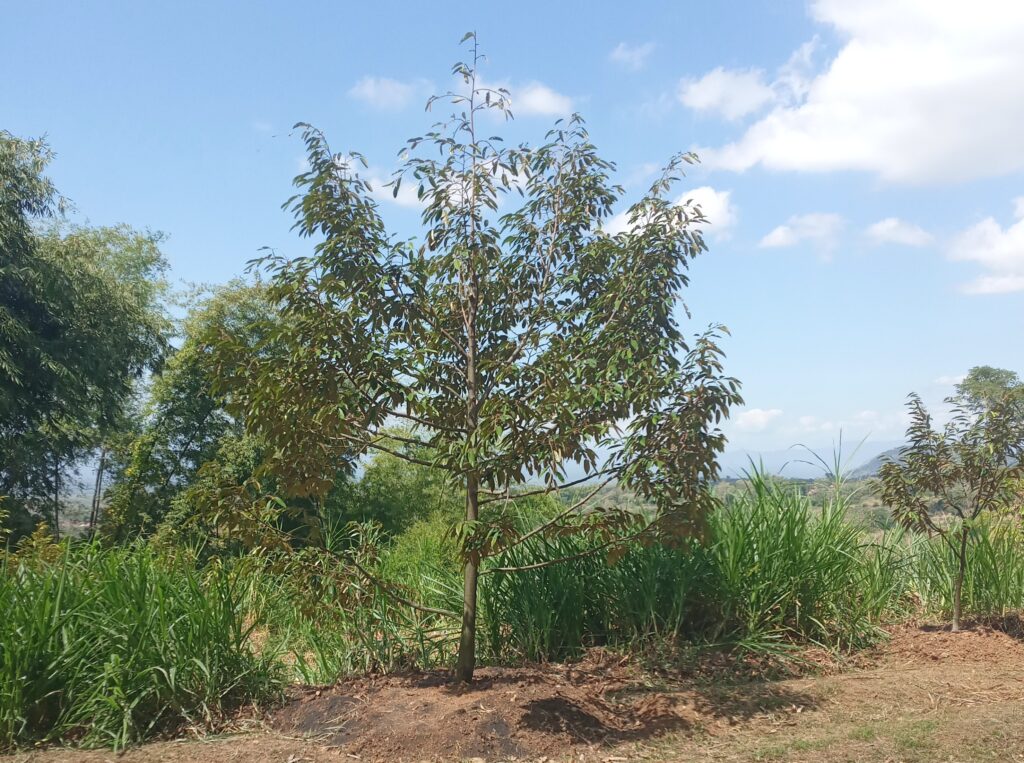
Pruning needs to be done: 1. Once at planting, 2. Shaping – when the tree reaches 2 meters in height 3. After entering the fruiting stage, sanitary pruning and thinning 1-2 times per year.
If you’re planting a tree up to 1 meter tall, you need to remove 1-2 lower branches and shorten the rest by one-third. Then the seedling will channel its energy to develop roots.
It is easy to identify branches that will bear fruit well in the future. They grow almost horizontally, at approximately 70° to the trunk (20-40° with the horizon line). Branches that are directed upward, downward, or inward, as well as weak ones, should be removed. If the majority of branches are directed sharply upward, you can cut the main trunk approximately 50-100 cm below the growth point (depending on the tree’s height). After this procedure, a new growth point will emerge from a bud on the trunk, and the crown will begin to form correctly.
In some varieties, such as D168/Masmuar or D24/Sultan, branches form a sharper angle with the trunk; branches need to be cut out 30-40 cm from the trunk. A secondary branch will grow from the bud, directed more horizontally.
If your trees are planted at a significant distance from each other (more than 8 m), you can leave branches that grow no lower than 1 m from ground level. In case of dense planting, branches below 1.5 m are usually completely removed so they don’t interfere with people walking in the garden, and it’s more convenient to care for the tree when it grows. Secondary branches that are closer than 50 cm to the trunk are also removed. The rest are thinned. The distance between secondary branches at each side is about 30-40 cm. Dead, damaged branches and water sprouts are also removed.
If the crown is very dense, it’s better to perform pruning in two stages in order to avoid weakening the tree and triggering water sprouts.
If your trees are young, up to 2 m tall, you’ll only need one hand pruning shear and a healing paste. For pruning large trees, you’ll need the following set of tools:
Hand pruning shears
Long-handled pruning shears 1 m
Pruning shears for high branches with a 2 m handle
Saw
Healing paste (salep kambium)
The cutting technique when pruning durians is similar any fruit tree. The cut should be angled (approximately 45°), not straight. The cut is made above an outward-facing bud (directed away from the crown center) so that the new shoot grows outward, not into the crown. This provides better lighting and ventilation.
The cut should be smooth and clean, made with one motion of a sharp pruning shear or saw. Ragged edges and bark tears slow healing and can become gateways for infections. The tool must be sharpened and preferably disinfected.
When completely removing a large branch, the cut is made along the swelling at the base of the branch, but not flush with the trunk, and without leaving a stub. Large branches are first sawn from below, then from above.
Thick branch cuts should be coated with healing paste after the cut dries, to prevent fungal spore entry. This is especially important for young trees up to 2-3 years old, as they are more susceptible to infections. In our garden, we don’t apply healing paste on mature trees.
Durian has to be shaped as a single trunk. If a seedling has two main shoots, first make sure that both are from the graft, not from the rootstock. The rootstock shoot is of course, we have to cut out. If both shoots are from the graft, choose the one that forms the crown better (branches directed horizontally). If both are approximately the same, leave the most developed one.